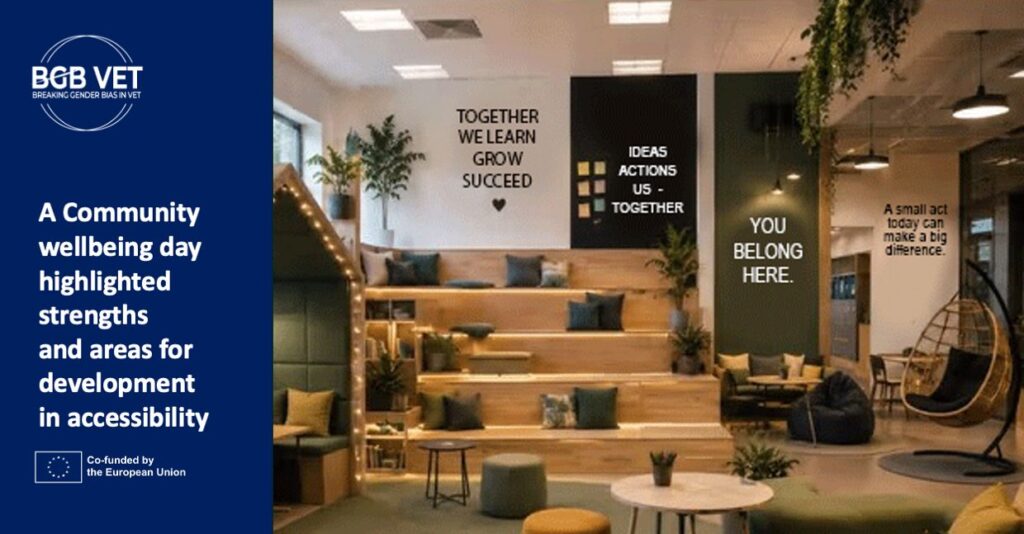
On 13 May 2026, our educational institution held a community wellbeing day, during which students had the opportunity to work together to improve the comfort, cleanliness and sense of community in the learning environment. Accessibility and inclusion from the students’ perspective were also at the heart of the day: what kinds of spaces and practices support equal participation and wellbeing for all students?
Accessibility in an educational institution means much more than removing physical barriers. It is a broad concept that looks at how every student can participate in learning on an equal basis, regardless of factors such as functional capacity, health, language background or learning difficulties. Accessibility is closely linked to inclusion, inclusive education and equality.
During the wellbeing day, student groups toured the institution’s premises and assessed how well physical accessibility is realised. They paid attention to issues such as the number of thresholds, the adaptability of spaces, lighting, sound environment and the variety of learning materials. They also reflected on psychological accessibility: how safe the learning environment feels, what the atmosphere at the institution is like, how teaching responds to the needs of different learners, and how easily help and support are available.
The results highlighted both strengths and areas for development. Students felt that the atmosphere at the institution was calm, safe and accepting. Help and support were considered easy to access, and students knew where to seek them. The physical spaces were also regarded as mostly functional: the corridors are wide, the spaces are bright, and the overall appearance is tidy.
However, many suggestions for improvement were also raised. For example, students hoped that different language backgrounds would be taken better into account in support services and signage, and that teaching would be differentiated even more strongly. In the physical spaces, attention was drawn to thresholds, heavy doors, the privacy and number of toilet facilities, and lighting that was dazzling in some places. The visibility and multilingual availability of emergency instructions were also considered important areas for development.
The day produced a wide range of concrete observations and development ideas that provide valuable information for the institution’s ongoing development work. The students’ views showed that even small changes can significantly improve the functionality and accessibility of the learning environment.
A sense of community and accessibility are built not only through physical spaces, but above all through everyday encounters. Shared events, functional break areas, group bonding, and a safe and accepting atmosphere strengthen the feeling of belonging. When barriers to participation are identified and removed, equality, equity and the experience that everyone belongs to the community are increased.
Developing accessibility is not only about adapting the environment; it is a way to promote diversity, wellbeing and everyone’s right to participate. That is why it is important that educational institutions continue to examine accessibility through students’ experiences.
Vocational education and training belongs to everyone!
by Maija Tuomola, Teacher, Lounais-Hämeen koulutuskuntayhtymä